Written by Sotiris Bekas
One of the things that distinguishes the truly great people of this world is that when they “depart,” everyone has a story to tell about them. That’s also the case with me.
The news of the passing of Petroloukas Chalkias (1934–2025) was difficult to take. Not because we were particularly close, but because I had known him almost my entire adult life. And for the past two decades, he had honored me many times by agreeing to give an interview—or at least to have a private conversation—in his Athenian neighborhood, Metaxourgeio, or at Karaiskaki Square.
The first time I met him was in the early 80s in Epirus, at my grandfather’s café, where he was waiting to go up to the upper part of the village for a concert. What struck me were his large, distinct fingers and his imposing presence. He visited our region often because of his close collaboration with Dimitris Vagias. They worked and recorded together for about ten years, right after Petroloukas returned from the U.S., where he had lived for roughly 20 years.
Much earlier, at the age of 11, young Petros crafted his first makeshift clarinet in Delvinaki from bouzia (wood without a “heart”). His only teacher was the great clarinet figure Filippas Rountas, who had in turn learned from the equally important Kitsos Harisiadis—Petroloukas’ relative, a first cousin of his grandfather on his mother’s side.
In one of our interviews, Petroloukas shared this story:
“As soon as my grandfather heard me, he sent me to Filippas Rountas. He had nine kids—ten with me. My grandmother and Filippas’ mother were sisters. One day, the teacher said: ‘I can’t give each of you an hour. I’ll show one person who picks it up quickly, and the rest of you will play what he plays. You, come here,’ he said to me. He saved me for last. He showed me something, and I played it immediately. ‘Alright,’ the teacher said. ‘Whatever Petros plays, you all play too.’
My fate brought me to where I belonged. One time, Rountas got drunk at a wedding and couldn’t play. ‘Call Petros,’ he told the other musicians. They came to my house at 2:30 in the morning and woke me up—we kids were all sleeping on mats. ‘Your teacher wants you,’ they said. I didn’t even know why. I got up, got dressed, went to the wedding, and was asked to play what my teacher had shown me. What could I do? I started playing loud. It was a big success! Around 6 a.m., Filippas woke up, heard me, and asked, ‘Who’s playing?’ That was it. He pulled me aside and said, ‘I don’t need to teach you anymore. From now on, you’ll be next to me.’”
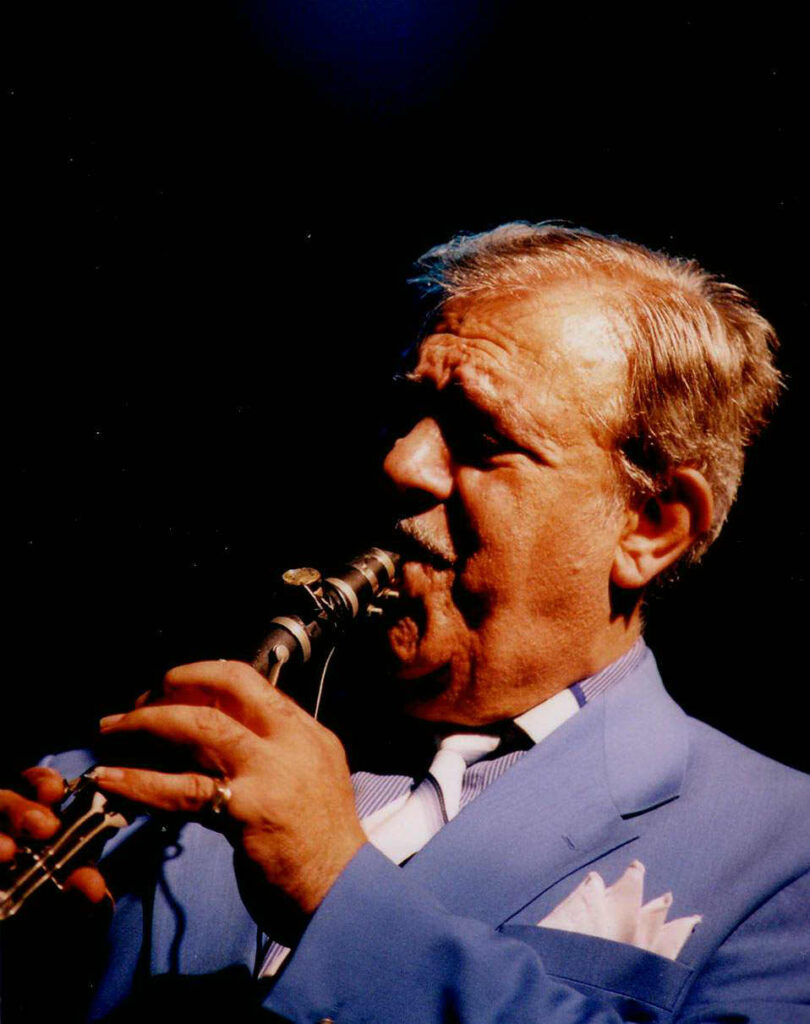
As I recall his story, I can still clearly hear Petros’ voice in my mind—calm and measured, the way he always spoke. He chose his words carefully, always aware of what would remain after him, though he truly had no need for words. He was dignified in both posture and speech, yet always had a smile on his face. He didn’t often “teach” other musicians, but he was incredibly generous—especially when he was in a good mood.
He became widely known as “Petroloukas” because of a printing error. When he first came to Athens, he worked with Alekos Kitsakis in the band of Tassos Chalkias. One night, a customer gave them a song they decided to record, which became a massive hit: “Aspro triantafylo krato” (I Hold a White Rose).
Both of them—being in their prime artistically and in age—were trying to break out from under the shadow of the towering figure who had shaped the music of Epirus. But when the record was printed, a typo on the cover and in the abbreviation of the name listed “T” instead of “P”—leading many to think that it was Tassos Chalkias on the clarinet, not Petroloukas. Following the advice of (musicologist) Spyros Peristeris, and to set him apart, he added the name of his grandfather (Loukas) to his own—and thus “Petroloukas” was born.
He wasn’t just a virtuoso or soloist. His breath had the quality of wind passing gently through trees—soft, melodic, and barely disturbing the silence. His playing was sweet and profound, almost metaphysical. His clarinet sang.
Petroloukas Chalkias was a charismatic, great musician with the rare sensibility of a true artist. He never rested. He always wanted to hear new ideas, explore new collaborations.
In the inner pocket of his coat, he kept his mobile phone, which held sound clips he had recorded of other musicians he had met or who had sent him recordings. When you sat with him for coffee, he would pull out the phone, listen, and motion you over to listen too—with the smile of a child sharing his toys.

To truly understand his artistic breadth, one must look beyond the expected. His two best solo albums—Mirologia kai Gyrismata and Dromoi tis Psychis (Laments and Turns / Paths of the Soul)—recorded in the 1990s, mark a good starting point. Around that time, he began collaborating with guitarist Takis Barberis, and together they performed at the jazz club Parafono in 1996. That encounter yielded the beautiful album In Parallel, which inspired Petroloukas’ participation in the series Greeks and Indians—a live performance where he played with Daya Shankar (shanai), Rakesh Chaurasia (bansuri), Shubhankar Banerjee (tabla), and Rabindra Narayan Goswami (sitar), curated by Alexandros Karsiotis.
A few years later, in the late 2000s, he was invited by the great Hungarian singer Márta Sebestyén to contribute to a masterpiece (still unreleased) that brought together Greek and Hungarian musical traditions. In just a few minutes on that recording, Petroloukas condensed all his signature ornamentations and phrasing into something of exceptional depth.
Most recently, he developed a close collaboration with laouto soloist Vassilis Kostas, producing two flawless albums under the fitting title The Soul of Epirus and The Soul of Epirus II. These works not only bridged the generational gap between the two musicians with great enthusiasm and energy, but also took listeners on a journey through songs and instrumental pieces that form the backbone of Epirotic music.
What he did manage to do, however, was to tell me that he’s leaving someone in his place — a student. His beloved grandson, who bears his name. Petros Chalkias.