Interview by Michael Polychronis
Lefteris Chavoutsas carried a “fateful” destiny even before his birth—one that seems to have followed him ever since. Had his ancestors, who came from Asia Minor to Greece and settled in Kokkinia (Piraeus) after 1922, succumbed to the calls of the then-Soviet Union—calls that from 1945 to 1948 promised a paradise-like life for Armenians across Europe—and had they decided to repatriate to the Soviet Republic of Armenia, young Lefteris might never have been born, many years later. Those who took the leap encountered an entirely different—dystopian—reality and were never able to return. Much water has flowed under the bridge since then, and the DNA of a musical people such as the Armenians seems to have been passed on to Lefteris, who came close to this art at the age of 13 and has never let go of it since. Since 2014, he has been leaving his mark on discography at regular intervals, through personal albums and collaborations, in addition to performing live and playing in various ensembles. He primarily serves the guitar, which is the core of his musical expression.
The conversation with him, however, prompted by the release of his latest album Sayat (Violin Production, 2024), reveals Lefteris as a wise child in the body of an adult. His almost ascetic presence is colored by structured speech, broad knowledge of his subject and beyond, and, above all, an aura of purity reminiscent of truly enlightened monks—those who have earned a place in the kingdom of Love through humility: love for fellow humans, for Art, and for a meaningful relationship with the gift of life.
How do you feel about the release of your second album, ten years after the first?
I feel very satisfied that I managed to complete it. Many of the pieces—some even a decade old—were recorded now, because I have to admit I’m not particularly prolific; I’m very careful about what I write. As my friend Antonis Apergis used to say, “You make good art when your trash bin is full,” meaning you need to discard a lot in order to keep what is useful and true. Anyway, there was also the limitation of the vinyl format—20 minutes per side—so I left out 3 or 4 ballads with piano, including one dedicated to Bill Evans. I kept the more interesting tracks that relate to the guitar, flamenco, and Latin American rhythms.
Tell us a bit about your choice of title. I sense a contradiction—the title doesn’t seem directly connected to the album’s content…
The title relates solely to my Armenian heritage on my mother’s side and is a tribute to Sayat Nova, whom I admired from a young age. He was an Armenian poet and musician who lived in the 1700s. Many of his songs survive and are still performed worldwide. The spirituality this man possessed enabled him to write poetry in four languages—Persian, Georgian, Armenian, and Tatar—simultaneously, each in the ideal form of its own language. As my brother, who works with language and translation, says: there is no superior or inferior language, as long as poetry can be written in it. Sayat Nova is an example of someone who proposed art as a means for the brotherhood of peoples—not as a way for one to dominate the other in the worst way.
Nevertheless, the content of the album leans toward the sound of Latin America…
That’s a love that comes from the guitar. Starting from each country’s traditional music—which is beautiful because it’s written to fit the measure of a human being, much like Cycladic houses built with the same logic—folk music is familiar to everyone. Starting from there and moving toward the more refined forms of music, with orchestrations and interwoven voices, I included some quartets on my previous album that, although stemming from classical music, are rooted in folk traditions. These pieces weren’t created overnight. For instance, even Baroque music and Bach’s compositions are quite familiar to both children and older people because they contain folk motifs. Vivaldi’s music, too, is approachable—even by someone with no musical background—because at the very least, it’s pleasant to listen to.
Since you mentioned Vivaldi, let me take you to the first track of the album, which—both in title and style—directly alludes to Manos Hadjidakis and The Smile of the Gioconda. Many consider it the greatest instrumental album in Greek discography. Hadjidakis had the ability to write demanding music that still resonated deeply with a broad audience. He managed to convey his refined sensibility to the public without being elitist, without looking down on the people—on the contrary, he had a desire to lift them up, to elevate them. He was, one could say, like another Sayat Nova, taking traditional or classical themes, even from Vivaldi, and transforming them into a universal Greekness.
So, this piece—“When the Clouds Drift Away”—is a tribute to both Hadjidakis and my favorite film composer, Kostas Kapnisis. And that’s because Kapnisis is closer to my own temperament—just like Rachmaninoff. He was extremely musically educated. For a single film, he would write a symphonic piece, a jazz one, and a folk tune. He had a broad understanding and a taste that touched me deeply.
Returning to Hadjidakis, he achieved what we mentioned earlier because his life itself was lived inside tavernas. Markos Vamvakaris once said, “Whoever messes with him will have to deal with me.” Hadjidakis was under his protection. He used to go there because he believed that was where real popular music lived. He even said that when he heard the song “Inside the Pasha’s Room” (1946, Matsas–Peristeris), he wished everything he ever wrote could carry the same spirit—that mix of optimism and melancholy, complaint and grandeur that this simple song holds. His life itself shows he never deceived anyone. Let’s not forget his famous lecture on rebetiko, the last music created by the Greek people after folk music—music that had been disowned by both intellectuals and conservatives. For me, rebetiko was a miracle!
Could a contemporary Greek musician write new rebetiko songs or evolve folk music today?
Yes, absolutely. A striking example is Fotis Vergopoulos’ album (Violin Productions)—he’s 35 years old and wrote 15 new rebetiko songs. The genre evolves. He wrote within that form with honesty and truth!
Do these genres ever get renewed? How can one create something new today within the legacy of the great rebetiko masters?
One example is what Stelios Vamvakaris did. His songs are both complex and simple, popular. Through his own lens, inspired by Markos’ music, he offered something new—although, truth be told, his songs haven’t been widely heard. This is what one must do to keep art alive: figurative painting and tonal music must continue, especially now that the era of atonal experimentation has run its course and everyone is returning to neoclassicism and classical music. It’s much harder to write a melody than an experimental piece. I believe everything in music is just beginning—now that we’re starting to understand what we really have in our hands!
From your last two albums, especially the most recent one, while someone might have expected you—because of your heritage—to continue exploring Eastern music, you seem to declare a deeper interest in the art of the guitar and its many expressive possibilities. This, after years of service to the instrument and your decision to leave the bouzouki behind.
In 2017, on the CD ZRUITS, we performed music from all eras of Armenian tradition, from Sayat Nova (1700s) to the 20th century. And in this album, too, there are two pieces that approach Eastern music. But as you said, with fingerstyle guitar playing—one of the most difficult techniques, even more so than bowing on a violin—I want to express joyful, danceable music with folk roots, like flamenco, Cuban salsa, or Argentine samba, while also evoking the easy listening sound of past decades, like Henry Mancini’s music. Perhaps, deep down, that’s who I really am!
Speaking of easy listening, in the mid-20th century, before the technology we have today, those maestros gave us orchestration masterclasses. I think even Hadjidakis drew inspiration from their orchestrations. They were composers, arrangers, and conductors who laid the foundations and showed us how rich a melody can become. In those large orchestras, every instrument had its place and strengthened each musical approach. After all, The Smile of the Gioconda was produced by the “magician” Quincy Jones. I believe we were wrong to underestimate this music as elevator or supermarket music.
And it all started from film music, which is something highly targeted—it has to serve specific scenes, reflect the characters’ psychology, and follow the plot. To do that, you had to be a true master of orchestration and the timbres of all instruments.
That sounds very much like what we now call empathy or emotional intelligence—translated into the logic of film music.
Exactly. A great example is Kapnisis and his ability to write film music—like the score for Stavros Tsiolis’ first film The Little Fugitive (1969). The musical theme in the opening credits has just four notes. Those four notes are exactly the same as Morricone’s theme for Cinema Paradiso, written 20 years later. That doesn’t mean anyone copied anyone. But if your antennas are open, it’s very likely you’ll catch the same signal as another great maestro—on the other side of the world, years later. Nothing is random, and nothing is easy when it comes to writing music for film. Among other things, you need to have open antennas!…
So, can I assume you’re open to composing music for film?
I think that what I already recorded could easily accompany scenes in a film.
In a recent interview, you said you’re not particularly interested in songwriting because you see it as a completely different perspective.
Yes, I consider songwriting a very difficult art form. Especially after the fall of the junta in Greece, there were so many songs composed where the word often took precedence over the music—sometimes to the detriment of the latter. That’s not necessarily wrong, of course. I just believe that music allows you to travel more. Like reading a book and then watching the film adaptation. The person who reads the book creates their own personal movie, their own landscapes, their own characters.
What did you find in the music of Latin America and Spain—since your album includes references to flamenco and some lesser-known Latin American musical idioms—that was different from the music of the Caucasus and the East in your previous work? What moved you to the point of capturing it in a recording?
First of all, there’s something very appealing about working with a musical style foreign to your own DNA. Of course, the guitar exists in all kinds of music, including Greek music. Flamenco already contains the East within it, due to the influence of the Arabs and the Roma. The second piece on the album, “Kentima” (“Embroidery”), is built around samba argentina. Just as Armenian music evokes associations with Mount Ararat, so too do the Andes, on the other side of the Atlantic, give their music a sense of purity, of pride. That emotion—the atmosphere—of these two regions is similar in their music. Armenia is a plateau, and the feeling among the people of the Andes is quite similar. That’s what I see as the shared element—along with the pentatonic scale, which is found across traditions and continents. It’s both more abstract and more earthy. So I come along with my guitar and discover that what attracts me is the music of the Argentine countryside—not so much the urban styles. I’m talking about samba argentina, chamamé, and chacarera. In the cities, the main urban form is tango, which evolved there much like rebetiko did here in Greece.
You mentioned the word “mountain,” and I can’t help but think that mountain people often have a kind of “union” with God—a privileged closeness. And I feel that in you. In your worldview, in the way you live and move, and also in the way you create art—not just music. I mean your other love: popular icon painting.
Mountains and union with the divine—that’s the metaphysical element we are essentially born with, but we forget over the course of life, or we’re made to forget it by the noise, the machinery, and the distractions of daily life. I hold onto a phrase by Zissimos Lorenzatos about the West, Europe, and our culture, where he says: “From the moment man shut the hatch of the metaphysical over his head, the problems began.”
Not everything can be measured with Western rationalism, the “dead” science that’s cut off from God and faith in the divine. I read an interview with a very accomplished doctor who said he always makes the sign of the cross before surgery, just like Saint Luke the Surgeon did—because often, he said, another hand is guiding yours. He claimed this had happened to him hundreds of times.
Just like icon painters used to say: “It’s not me painting—the hand is moved by someone else.” And it’s done with a purpose, beyond the everyday world and what we can see.
Can love be measured with a ruler? Love is everything. It’s what John said: “God is love.” There is nothing else. If we forget that, we forget that we are human.
When it comes to icon painting, are you more drawn to its classical form, or do you aim to take it further?
Everyone moves it forward in their own way. What we call Byzantine painting was simply the style of that era—a continuation of the Fayum portrait tradition of the Hellenistic period. Those portraits were mostly made by Greek painters in Egypt. They were painted for the dead—but they’re anything but lifeless. When you look at them today, you feel like they might start talking to you. That’s where the idea of the icon began.
The Byzantine icon evolved from that. Each painter added their personal touch without it being obvious or turning into a formula. Formula came later, with the Cretan School around the 19th century, when there was an obsession with detail and the figures became almost geometric.
What interests me is folk character—what Kontoglou did, who painted secular themes as well as saints. Always with a healthy sense of Greekness, like what you see in the work of Tsarouchis too.
What I’d love to do is create an easy-listening version of that art (laughs)—something that’s pleasant to look at and to experience. The most important thing is to be drawn to Beauty—the Ideal!
When you speak about religion or the divine, I sense that you’re actually talking more about spirituality—that seems to be what truly defines you.
I would put it like this: theology—the engagement with metaphysics, the divine, and the word of God—should ideally be practiced as practical theology, meaning as a reference to one’s fellow human being. You can’t do anything without the concept of your neighbor, of offering yourself to them. That’s what spirituality is for me, as reflected in the parable of the Good Samaritan. That’s the kind of spirituality I want to serve—through both music and painting.
Spirituality is often associated with asceticism. From everything you’re saying, it sounds like someone who wants to serve in this harsh world is automatically led to isolation, to a kind of solitude. How present is that in your life?
To a very large extent. On the one hand, there’s the natural flow of life, and on the other, solitude is necessary—you need to be alone, to study, to be undistracted, to devote your whole life to art. All the greats did that. Which of the greatest artists wasn’t an ascetic? Karouzos lived in a basement and often had nothing to eat. Tsarouchis, when he was in France, lived for a month on eggs because he didn’t have money for food, and he would copy Karagiozis shadow puppet posters.
Do you think this helps or hinders creativity?
It helps, as long as you face it with patience. It’s essential for creation, and at the same time, it’s something you owe to do. You owe it to yourself not to waste a single second of your life. That’s something everyone noted about Kazantzakis—he didn’t want to waste even a minute of his time.
How do you practice or study music?
When you’ve reached a certain point and have absorbed some fundamental techniques on your instrument—especially in the music that moves you and which you want to approach more deeply—you begin to listen to very specific things. You try to make your study time as productive as possible. Out of seven hours, maybe only one is truly meaningful. On the other hand, you also need long breaks and to really live your era—to stay inspired, and also to criticize what disturbs you by doing the opposite: offering something healthy and spiritual through your art—something with real value, always in the popular sense.
Are there any musicians you consider your teachers or mentors?
I wish I could have experienced the educational environment and the musical approach of Rachmaninoff and Scriabin. Their teachers, like Tchaikovsky, the settings they lived in—immersed in nature without today’s conveniences—and in what was probably the final and perhaps best era of Romanticism, the Russian school, which was the counterpoint to the Western one. I actually believe the balance across all the arts tilts in favor of the Russian school. The emotional depth these people brought to music, painting, and literature is unparalleled.
Scriabin, for instance, envisioned a multimedia spectacle of sound and color. He wanted to build a system of colored spotlights where each hue would correspond to a musical harmony, because he believed every harmony was a philosophical idea. So, the way you blend harmonies reflects your philosophy—and how your thinking evolves in general.

What you’re saying reminds me of the great teachers of the East, who openly spoke about the connection between music and the world of energies and vibrations. I suspect many great Western musicians—some more, some less—were initiated into those paths as well.
But art itself leads you there. If you dig deep enough, you see that everything is connected: colors, vibrations, sounds, words, meanings, philosophy, thought, your way of perceiving life—even the movements of the planets…
And the deeper you go, the more humble you become—at least potentially.
Jazz musicians, who were often never paid well and yet were the most revolutionary, made freedom of expression a lived experience through improvisation. The humblest, perhaps, are jazz musicians.
I have the feeling your compositions are timeless. They could have been written in the ’50s, ’60s, or ’70s. In Greece, in which era would you have liked to live?
The 1950s—both in Greece and globally. I really love the aesthetic of that time. Humanity had just emerged from World War II. It was the last era when people were closer to nature, when human behavior had more dignity. Of course, there was still hardship.
My generation, I think, caught a faint scent of that era’s end.
If you notice what was typical in a simple piece from that time—since you brought up the timeless quality of my work—the orchestration would consist of piano, double bass, vibraphone, and flute, maybe with the first electric guitars. A characteristic example is the opening track of my album, “When the Clouds Drift Away.”
Have you ever been approached to compose music for film?
Yes, for documentary music. Giorgos Fetouris and Gina Apostolopoulou, who made the video clip for the track we talked about earlier, have an enormous amount of footage from their travels in India. They’re planning to create a documentary using the unique imagery they’ve collected.
Lately, artificial intelligence has become a dominant topic, especially as it’s begun invading music composition. That raises questions: if there’s no clearly stated creator, there are no rights, meaning composers and performers could be pushed aside. How do you view this development?
The capabilities of AI are truly astonishing. What would scare me is the potential for things to spiral out of control. On the other hand, I’m not that worried because, honestly, I’d be curious to hear a taximi (improvised solo) generated by AI. After all, it’s a human creation. People say it will surpass human intelligence and enslave us, but I believe that what moves people emotionally, what they fall in love with—AI will never be able to truly express.
And even if an AI-generated taximi moves you emotionally, knowing that it’s the result of data, not “blood,” doesn’t that automatically make it somehow lesser?
AI is constantly being fed human information. There’s a Sufi interpretation of taximi—which is the heart of the East, spirituality itself, the communication with the divine—that says: “Taximi is the moment when, after the wedding, the two lovers are alone in the bridal chamber.” Taximi is pure love, ultimate purity, the complete union with the divine. “And the two shall become one flesh.” That’s something I don’t think AI will ever achieve: the ability to be in true communion with another human being, to see the face of the other—because every person’s face is the face of God.
In the end, AI might give you answers that move you, but it will never visit you in the hospital when you’re sick.
Would you consider dedicating an album to reinterpretations of songs you love? What might that include?
I would love to. I’d like to reinterpret the jazz songs from Greek cinema, like those composed by Kapnisis. I couldn’t do that with rebetiko—they’re already perfect. But jazz music opens up a lot more space for reinterpretation, as long as you know exactly what you want to do when offering your own version. Also, I’d be interested in arranging Eastern monodic music—monophonic songs—using strange harmonies that could suggest something entirely new.
Up to now, your albums have been thematically focused, each one built around a specific style or sonic palette. Could you see yourself making a more eclectic album?
Absolutely—and perhaps that will be my next one. For instance, I’d be very interested in making an album with solo oud pieces, which I see as the root of the guitar.
What kind of music would you pair with your paintings?
I think mostly music from the East, perhaps because of its connection to icon painting. It’s more abstract.
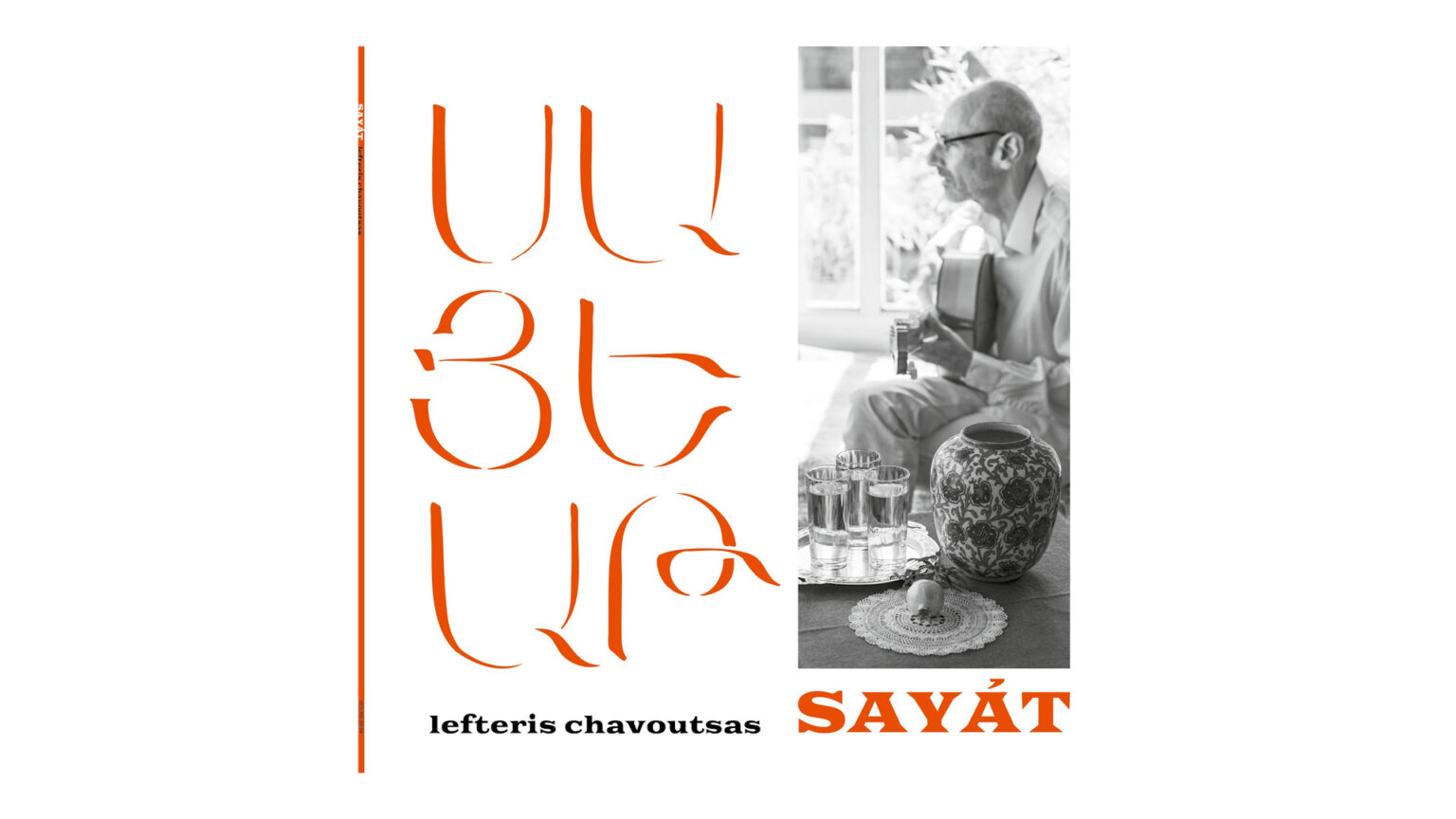
Yet for this album’s artwork, you didn’t use your own painting but instead chose symbols—besides the typeface, which points to your heritage. Tell us about them.
The photograph is taken from my home. It contains three elements: art, as a response to the hardships of life and a defiance against the ugliness and apathy we’ve all been guilty of at some point; the metaphysical, representing faith in the divine; and a will to live.
Art is symbolized by the vase—a 1928 heirloom from my grandfather—crafted in the Kütahya tradition of handmade Armenian ceramics and decoration. Art is also present in the embroidery from my grandmother that covers the table.
Faith is symbolized by the three glasses, representing the Holy Trinity.
The will to live and survive is represented by the pomegranate—a symbol of Armenian survival during the 1915 Genocide. Many who were driven into exile in Syria survived by eating one pomegranate seed a day. Even today, if you dig in certain places in Syria, you’ll find bones of the deceased. My grandmother’s uncle survived the genocide in just such a way.
On the back cover of the album, there’s a calligraphic Armenian phrase: “Man will believe in God.” This phrase was engraved by an Armenian engraver on an Ottoman postal stamp in 1913, which depicts a scene from the Bosphorus and was printed in England. Under the words “postal ottoman” there are vertical lines. Armenian letters, when written vertically, appear uniform—like a cardiogram. The engraver managed to hide this phrase as the shadow of the letters, visible only with a magnifying glass.
Three years later, the Turks discovered it and attempted to scrape the phrase off the stamps. The stamps were withdrawn, and the engraver died in prison.
So, I wrote that phrase myself on the back cover of Sayat.
“SAYAT” is available in digital format on all streaming platforms and on vinyl record!
Listen and buy “SAYAT” here
https://violinsproductions.bandcamp.com/album/sayat